
Showing posts with label Savoury. Show all posts

Tuesday, 28 May 2013

Week 36 - сніданок - Ukraine

KASHA

"Eat breakfast yourself, share lunch with a friend, give dinner to your enemy."
                   -Russian/Ukrainian proverb

As I've gotten older and explored other cultures I've found myself more curious about my own cultural heritage.  Like many Canadians, I have roots in several different countries and we've explored some of their breakfasts already (the Full English and Danish Ollebrod).  Today, we're going to look at Kasha, a buckwheat porridge, and see if it ignites my Ukrainian spirit.

Kasha is an ancient breakfast that is enjoyed in many ways across Eastern Europe.  It can refer to various grains (wheat, oats, barley, millet, or rye) but for our purposes let's look at buckwheat groats.

Buckwheat groats (which are actually a seed) are astonishingly good for you.  A quick google search shows sites claiming that buckwheat groats are high in amino acids, protein, vitamins and fiber.  They're also touted as a strong preventative measure for a number of ailments including cardiovascular disease and are friendly to those suffering from Ceiliac disease.  You could almost say buckwheat is the new quinoa...

But how to prepare it for breakfast.  Simple really.  You boil the Kasha with water or milk (about 1:2 ratio) on the stove top until the Kasha has reached the desired consistency.  Similar to Oatmeal, everybody has their preferences - some like it soupy and mushy, others prefer it crumbly and a bit drier.  Once it's done you can top it with various toppings.  We went with butter and honey and just a touch of cinnamon.
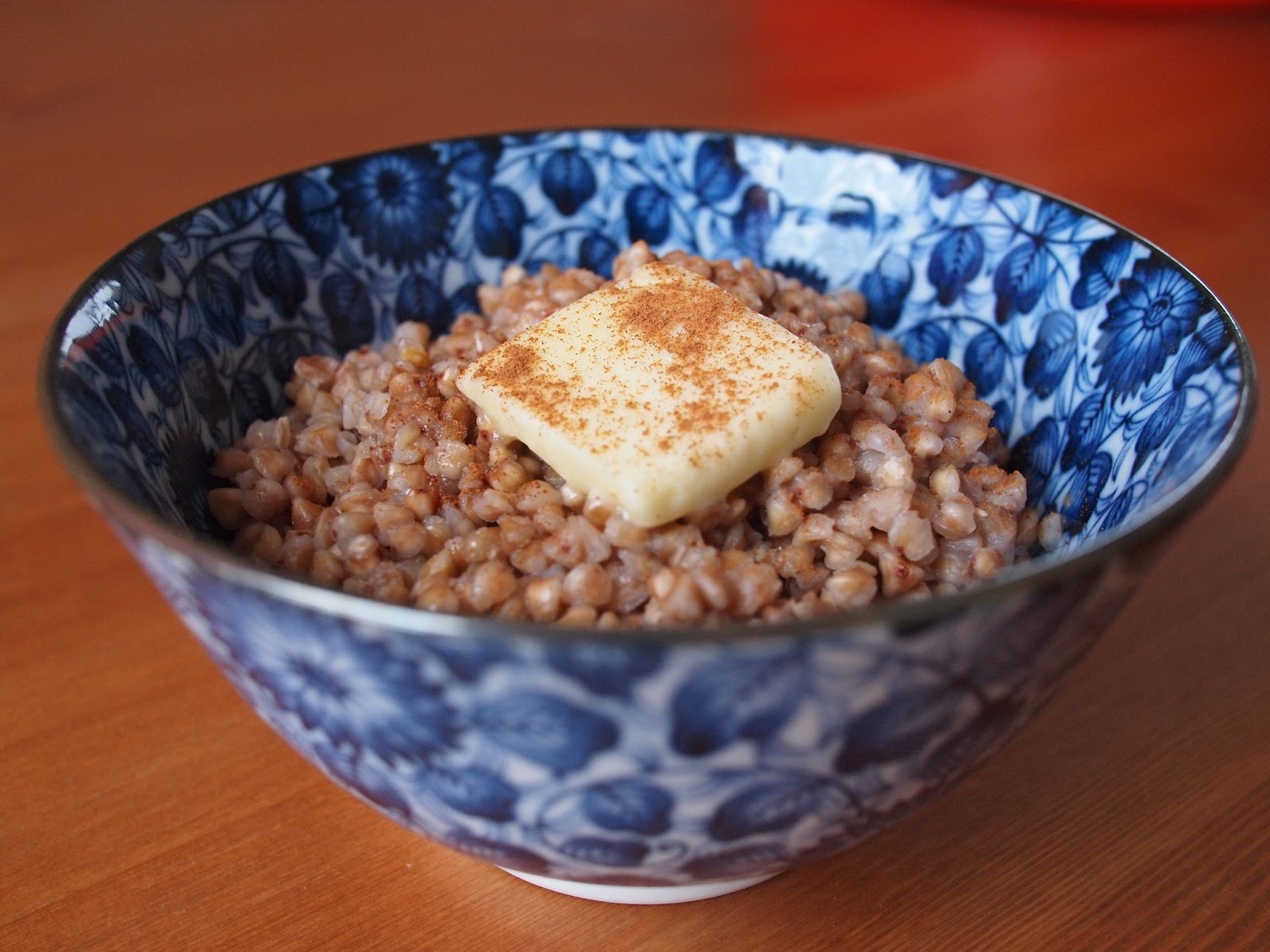


At first bite Kasha was delicious.  The texture was really the starring feature.  It was a little toothsome but also crumbly.  The flavour was nutty and smoky, owing to the fact the groats are roasted, and something about it really evoked a Eastern European atmosphere.

However, I found an entire bowl of Kasha to be overwhelming.  Perhaps due to the high fiber content, it sat in my stomach like a bowl of lead.  And sad to say, I didn't come close to finishing my bowl.

The Verdict:

For Ease of Preparation:


For Degree of Separation:


For Guestability:


For Sustainability:


If you have a long morning ahead, consider Kasha.  We weren't hungry for a looooong time after just half a bowful!

For Costability:


If you can find an Eastern European market this stuff is cheap.  For quite a large bag we paid only about $2.

For Overall Appeal:


Kasha was a nice change from oatmeal and if it didn't bother my stomach so much, I would explore more recipes.  (It can also be eaten as a savoury side dish for supper.)  I would urge everyone to try it.  The taste was definitely interesting and with such a long list of benefits, it seems worth adding to your diet.

I'll leave you today with some fun Kasha quotes I found:

"He has Kasha in his head." - He's a mess.
"Cabbage soup and Kasha are all we need to live on." - Shows the importance of Kasha to the Russian/Ukrainian diet.
"He ate too little Kasha." - He's weak.

And my favourite....

"You can't make Kasha with him." - He's useless.

Wednesday, 15 May 2013

Week 35 - ארוחת בוקר - Israel

MATZO BREI

Matzo Brei is a simple breakfast made by frying Matzo (a thin cracker-like unleavened bread) with egg.  Similar to French Toast, Pain Perdu and Torrijas in execution, Matzo Brei is normally served during the Jewish holiday of Passover. (During this holiday all leavened grains are forbidden.)

You don't have to search very far to find people claiming to have the "definitive" Matzo Brei recipe on-line.  As an easy home recipe, Matzo Brei is the kind of comfort food that has thousands of variations - each of which is "the best".


Matzo Brei can be served sweet with cinnamon sugar or savoury with garlic and onions.  It also can be made with a wet consistency that almost resembles a Fritatta or it can be made more on the dry side.  We made sweet of course, (cause that's how we roll) but check out this video where renowned architect Frank Gehry talks about his preference:


After Torrijas, Matzo Brei (as prepared by me) just didn't compare.  I found it dry and lacking in flavour and upon taking a bite Jon pondered, "maybe you made it wrong?"  The truth is that maybe I did.  Maybe our preferred Matzo Brei is savoury, or maybe we would've liked it with more egg.  In any case, a recipe as popular Matzo Brei absolutely deserves another shot.


The Verdict:

For Ease of Preparation:


Matzo Brei rivals Hagelslag in simplicity.  From start to finish in under ten minutes.

For Degree of Separation:


For Guestability:


A tricky call.  As primarily a holiday breakfast, Matzo Brei seems fancy enough for guests.  And yet there is a certain austerity to it that makes me hesitate to serve it to guests.

For Sustainability:


For Costability:


At it's barest minimum Matzo Brei requires only three ingredients!  Matzo, eggs, and some kind of fat to fry it in.  Beyond which, part of Matzo Brei's charm is that it was partially developed as a way to use up extra Matzo during and after Passover - extra points for being economical.

For Overall Appeal:


I'd try Matzo Brei again.  I'd be especially interested to try it made by somebody with more cred.  So here's an open invitation - does anybody have an amazing Matzo Brei recipe they'd love to share?  (Or better yet make.)  Was your Bubbe the Matzo Brei master?  How do you like your Matzo Brei?  Let me know....

Next week we go old school as we look into what my Ukrainian ancestors ate.  Will it be delicious?


Friday, 10 May 2013

Week 34 - ăn sáng - Vietnam

BANH CUON

Breakfast in Vietnam is decidedly savoury and usually centres on some form of rice.  If you've had Vietnamese cuisine, many foods eaten for breakfast will be familiar - Pho (meat-based clear soup with noodles and herbs), Banh Mi (a sandwich on French-style Baguette featuring eggs, meat, or pate and fresh herbs and vegetables), and Balut (an almost ready-to-hatch duck egg).  Ok maybe this one doesn't make it to many North American tables but I guarantee that unless you've visited Vietnam or have Vietnamese ancestory you've probably never heard of today's breakfast - Banh Cuon.


Banh Cuon is a very light rice flour crepe that has been stuffed with ground pork, minced shallots and minced wood ear mushrooms.  It is served with sides of fresh cucumber, bean sprouts, Cha Lua (Vietnamese pork sausage) and the dipping sauce Nuoc Cham.

It's Northern Vietnamese in origin and today is enjoyed throughout the country for breakfast and as a late night snack.  (Isn't funny how often breakfast foods double as late night snacks?)

I was hesitant to make this one at home.  The ingredients seemed difficult to find and the crepes are typically made on a special pan that is fitted with a metal hoop that stretches a layer of cloth over the pan.  (Not something I was likely to find at my local Home Outfitters.)  But there were several really great tutorials on-line and in the end I decided to take the plunge.


Finding the ingredients was the first challenge.  I was confidant that my local T & T Asian Supermarket would have everything I needed, however figuring out where they were in the store and identifying them among the hundreds of non-English labelled products was another matter.  Rice flour....check, tapioca starch....check, Nuoc Cham.....check, wood ear mushrooms.... negative.  Where the heck would we find wood ear mushrooms.  They weren't in the fresh produce section and similarly were nowhere to be found among the dried mushrooms.  With some help from my smartphone, I finally found them in a mysterious package labelled - Black Fungus.  Delicious....

I was ready for an equally difficult time with the rice crepes, but following the recipe had little trouble. (Hurray for well-written recipes!)  The filling had a horrendous fishy/pork smell as it was cooking and I started to regret putting Jon through this experiment in Vietnamese street food.  But he's always such a great sport so we plated it up and dug in....

And I am happy to report that it was really good!  I've read that Vietnamese cuisine is based on the yin and yang of the five elements and it turns out this is the beauty of Banh Cuon.  The salty, earthy meat filling (which smelt so off-putting) was balanced by the fresh crunch of the veggies and sweet/sour Nuoc Cham.  There was also a myriad of textures and aromas - soft and silky, hard and crunchy, warm and crumbly.

CorrespondenceElements[5]
WoodFireEarthMetalWater
Spices (ngũ vị)SourBitterSweetSpicySalty
Organs (ngũ tạng)Gall bladderSmall intestineStomachLarge intestineUrinary bladder
Colors (ngũ sắc)GreenRedYellowBlackWhite
Senses (năm giác quan)VisualTasteTouchSmellSound
Nutrients (ngũ chất)PowderFatProteinMineralsWater

The Table of Elements in Vietnamese Cuisine - Wikipedia

The Verdict:

For Ease of Preparation:


I have a confession - we made this for supper.  And as a dinner, this was a fun endeavour. But it's definitely way too involved for breakfast.

For Degree of Separation:


Black fungus, fish sauce and ground pork, need I say more?


For Guestability:


For Sustainability:


For Costability:


I expected this one to be expensive, but T & T is one cheap supermarket.

For Overall Appeal:


I can see why Banh Cuon is not more well-known outside of Vietnam.  It's not an easy entry food to Vietnamese cuisine.  However if you are looking for something that captures an authentic morning at a street stall in Hanoi, I encourage you to give it a shot.  Putting together the recipe was my favourite kind of tactile kitchen experiment.

Well cherry blossoms and magnolias have finally blossomed here in Toronto, a sure sign that my entry on Passover breakfast is way overdue!  Check in next time to see us try Matzah Brei...


Monday, 29 April 2013

Week 33 - Desayuno - Venezuela

AREPAS CON PERICO

In case it isn't obvious, I love exploring food traditions and histories of various cultures.  Venezuela is a country that until now had escaped my attention... but no longer!

If you had to sum up Venezuelan cuisine with just one dish it would be the Arepa.  Arepas can be eaten anytime of day, as a snack or a meal and are a unique food to this part of the world.  Although they are also enjoyed in Colombia and to a certain extent in a few other Latin American countries, Arepas are most often associated with Venezuela.


Arepas are basically small buns made of special cornmeal (white P.A.N. is the most common brand).  They can be grilled, baked, steamed, boiled, etc. but are usually fried on a heavy cast iron-like pan before being split open and stuffed.  Fillings range from meat to seafood to cheese to strictly vegetables.


For my first Venezuelan breakfast I chose to stuff my Arepa with Perico, a colourful scrambled egg dish.  Perico means "parakeet" or "parrot" in Spanish and is an apt name for the mix of tomatoes, eggs, onions, and cilantro that make up this Caribbean version of scrambled eggs.  Garnished with some Guasacaca (Venezuelas irresistible vinegary cousine to Guacamole), Arepa con Perico certainly lived up to it's namesake!


The Arepa itself was quite bland but I found it pleasing in texture with a soft middle and crisp outer layer.  And really the Arepa is a vessel for what goes inside.  In this case the Huevos Perico and Guasacaca with Quesa Fresca (unriped soft white cheese) did not disappoint.  The Egg lent meaty substance, the avocado a lxurious creaminess and the vinegar and garlic cut through with a one-two flavour knockout.

What I find most interesting about Arepas is that they're not more well-known around the world.  They really are a perfect blank-slate for experimentation and since the modern version uses pre-cooked cornmeal and very few other ingredients they are extremely easy to make.  Like the cupcake, taco, and donut before them Arepas scream out to be the world's next food fad!

The Verdict:

For Ease of Preparation:


For Degree of Separation:


Were it not for the familiar presence of eggs, Arepa con Perico would get a solid five cheerios in this category.

For Guestability:


I'm going to go out on a limb here and say this would be excellent served to guests.  For presentation factor alone this food deserves it's spot on the B & B roster.

For Sustainability:


I feel like I'm gushing, but Arepas really have it all.  Taste, looks, nutrition, you can't go wrong here.

For Costability:


Like many flatbreads, the Arepas themselves are extremely inexpensive.  Cost here varies on what you put inside....

For Overall Appeal:


A Solid four Cheerios.

This meal was hearty enough to wander straight into weeknight supper territory for me and if I was a Vegetarian I would be doing a Tom Cruise couch jump over this versatile new food discovery!

Join me next time as I brave fish sauce and black fungus to discover what's up in Vietnam....

Saturday, 20 April 2013

Youtube Breakfasts

While searching out new breakfasts I often come across great videos on Youtube, some of which I've already shared (Burek, Jumbo Breakfast Roll).  My favourite are videos on location because they really capture the authentic flavour and mood of the meal.  In fact, this entire blog was inspired after watching a video about a Pakistani breakfast called Halwa Puri.  Please enjoy it and others I've come across:

Halwa Puri:


I find everything about this video so fascinating.  What does this breakfast taste like?  Is it sweet, salty, spicy?  I have no idea.  And how do you eat it out of those plastic bags?  (Not to mention the mystery of how they get everything in them without making a mess!)  We've yet to try Halwa Puri, mainly because it seems like good breakfast excursion and I've yet to figure out where to buy it in Toronto. (Although I don't doubt that it's out there somewhere...)

Knefe:


You may remember Knefe from the Lebanese breakfast entry.  The first time I saw this video I immediately texted Jon to tell him that I wanted to add this machine to our kitchen...

Kaya Toast:


Kaya Toast is virtually unheard of food here in Canada, but this commercial gives a real window into it's popularity in Asia.  It almost rivals Tim Horton's with it's sappy sentiments.

Depression Breakfast:


This great-grandmother is 93 and has her own vlog about cooking on Youtube!  Incredible.  Even more incredible, she says they ate cookies for breakfast during the Depression years...

Plov:


The national dish of Uzbekistan, Plov or O'sh is eaten all times of day.  But in this video it looks like they're enjoying it in the traditional feast held the morning before a wedding.  O'sh is serious business and the men of the family pride themselves in their O'sh making skills the same way a North American man might pride himself on his BBQ-ing.  You'll notice that only men are invited to this particular occasion.  Exclusive perhaps, but these feasts have been known to feed as many as 1000 men at a time - that's a lot of rice!

Pastechi:


Okay, this video loses me around Dr. Horatio Kilpatient's appearance, but I do like getting to see a bit of Aruba and the food cart scene.

Sesame Street:


What does Cookie Monster eat for breakfast?  Watch to find out.....

Thursday, 18 April 2013

Week 32 - 早餐 - China

CONGEE with YOUTIAO

Congee is a food I've been familiar with for a long time.  There are tons of restaurants across the Toronto area named after this dish and I've seen many a co-worker devour a bowlful for lunch.  But I've got to admit, up until now I've never had any inclination to give it a try.

Besides the foreignness of eating limp rice in the morning, consider its appearance.  As a mass of congealed off-white gruel, congee sure isn't winning any beauty pageants.  Creative sprigs of green from assorted toppings do help, until the spoon goes in and finds the often offensive mystery meat!

So imagine my surprise when despite my trepidation, I discover Congee to be.... amazingly delicious.  Comforting even.


Of course, it helps that this particular Congee was made by me with very little in terms of scary ingredients.  And actually, there are very few ingredients at all that go into Congee - something I'm learning is a plus when cooking a tasty breakfast.

Besides being the breakfast of choice for China, variations on Congee are popular all across Asia.  The recipes vary quite a lot but they all centre around rice that has been cooked to the point of disintegration in many times it's volume in water (8:1 is a common ratio).  Congee doubles as a nutritious meal and a great way to use up left-overs.  It is also commonly seen as an excellent pablum for babies and tonic for the sick.


Congee in China is most often served with Youtiao (seen above).  Here's what Wikipedia had to say about this salty doughnut-like pastry:

The Cantonese name yàuhjagwái literally means "oil-fried devil" and, according to folklore, is an act of protest against Song Dynasty official Qin Hui, who is said to have orchestrated the plot to frame the general Yue Fei, an icon of patriotism in Chinese culture. It is said that the food, originally in the shape of two human-shaped pieces of dough but later evolved into two pieces joined in the middle, represents Qin Hui and his wife, both having a hand in collaborating with the enemy to bring about the great general's demise. Thus the youtiao is deep fried and eaten as if done to the traitorous couple. In keeping with the legend, youtiao are often made as two foot-long rolls of dough joined along the middle, with one roll representing the husband and the other the wife.

Saucy!

I had every ambition of making these at home but a little research showed that these are a bread best left to the pros.  (If you're in Toronto stop by King's Noodle where you can buy Youtiao to go).

The Congee variation I made featured a healthy dose of ginger and chicken.  The texture was smooth and far from being exotic, the flavour was rich and familiar.  It had all the goodness of home-made Chicken Soup with the soothing "stick to your ribs" heartiness of Oatmeal.  I liked it so much that I ate it for a good five days afterwards.

The Verdict:

For Ease of Preparation:


At it's easiest, Congee is as simple as boiling together water and rice.  With just a little additional effort it can become worth getting up for.

For Degree of Separation:


For Guestability:


For Sustainability:


For Costability:


Traditionally Congee has also been used to feed many people with little food.

For Overall Appeal:


Congee caught me by surprise and I am delighted.  I guess I should've known that several billion people couldn't be that wrong....

For next week, I leave you with a riddle.  What food is both a vegetable, starch and sandwich casing all at once?

Tuesday, 26 March 2013

Week 29 - Kwizija - Bosnia and Herzegovina

BUREK

It seems the world is rediscovering the Balkans as a beautiful and inexpensive tourist choice these days.  A friend who recently went to visit, extolled it's virtues and when asked if they had any exceptional food didn't hesitate to answer, "Burek."


Bosnian Burek is a puff pastry made with ground meat, onions, and a touch of paprika.  It's artfully swirled into a spiral shape and served warm with yoghurt.
 They are primarily a street food and are found in specific bakeries called Burekdžnica. 


Versions of Burek can be found all over Eastern Europe and even into Arabia.  Some versions feature cheese, others vegetables like spinach or squash and yet others have various meat and veggie combos.  You could even say that Bougatsa, from Week 5 - Greek Breakfast (still my favourite breakfast of all time) is a distant relative to the Burek.


Unfortunately there are no Burekdžnica near us in Toronto, so I had to try my hand at this Balkan delicacy.  I was dubious that I would be able to achieve the thin layers of pastry indicated in the recipe, but almost like magic, the dough easily stretched to see-through thinness and was really easy to work with. After making the meat mixture, I rolled it and doused it in copious amounts of butter and oil.  The aroma of it baking in the oven was mouthwatering and worth getting out of bed on a cold March morning...


Altogether, Burek was delightful, especially fresh from the oven.  The pastry although still flaky was a bit more chewy than store-bought phyllo.  For my taste, ground beef is a bit heavy in the morning but the yogurt really helped to lighten it up.

The Verdict:

For Ease of Preparation:


Well, maybe I didn't just whip this one up in five minutes, but honest, it wasn't so bad and could totally be made ahead.

For Degree of Separation:


Pretty much anything with meat (that's not bacon) gets five Cheerios in this category.

For Guestability:


Although a bit weird for guests, you gotta admit it's quite impressive looking...

For Sustainability:


For Costability:


For Overall Appeal:


This was perhaps not the most delicious breakfast we've tried, but it was oddly satisfying.  In the future I might bring this back as a supper food.

It seems the Jumbo Breakfast Roll is not the only breakfast food to be immortalized in song!  Check out "Burek" by Bosnian musician Dino Merlin: