Tuesday, 2 October 2012

Week 10 - Mexico


CHILAQUILES & ATOLE

Who here loves Mexican food?  I know I adore it.  I was hooked after that first Taco in Grade 7 Home-Economics class and many a Taco later love it more than ever.

Researching breakfast in Mexico was a bit overwhelming because there really are a lot of breakfast options, and each has its own endless regional variations.  There's Huevos Rancheros, Migas, Gorditas de Harina, Breakfast Tacos...but the winner of my attentions was Chilaquiles - or more simply, breakfast nachos!


As soon as I learned that Chilaquiles existed, I had to try them.  Nachos, normally relegated to the dark of night brought into the morning light!  Very exciting.  And as it turns out, simple to make.

Chilaquiles perform the same function as many other breakfast foods - to use up last night's dinner.  Just like Sinangag last week used up left-over rice, Chilaquiles use up left-over tortillas.

Very simply, you fry up strips of tortillas to make Totopos (or nacho chips as we North Americans know them), quickly cook in a pot with Salsa, drizzle with Crema Mexicana (a thinner version of sour cream) and Queso Fresco (fresh, unripened Mexican cheese) and serve alongside Frijoles Refritos (refried beans).


Awesome.  Spicy, delicious, and lots of protein to start your day!

But wait... it gets better.  Unlike 99% of the countries I've researched, Mexicans don't all drink coffee at breakfast.  The predominant drink of choice is Atole.  Atole can be traced back to Mayan times and is a creamy hot drink made with Maizena (corn flour or corn starch), milk, sugar and vanilla (when mixed with chocolate it becomes Champuraddo).  It is fragrant, delicious and wraps around you like a hug on a cold winter's day.  A definite keeper!


The Verdict:

For Ease of Preparation:


If you use pre-made tortillas chips this recipe is a cinch.

For Degrees of Separation:


Not even close to Cheerios.

For Guestability:


For late night sleep-overs with friends - yes; for a nice brunch with the family - maybe not.

For Sustainability:


I could eat a lot of these before I felt truly satiated.

Overall Appeal:


I think it is easy to tell that I loved this breakfast.  It was easy to make and super delicious - hallmarks of a great morning meal.

This was a fun spicy way to wake-up, join us next time for the island-vacation special brought to you by Samoa!

Monday, 17 September 2012

Week 9 - Agahan - The Philippines

LONGSILOG

Dear readers, due to an extremely hectic couple of weeks this entry is over two weeks late!  My apologies....

For our second breakfast this weekend we tried some Filipino Agahan (breakfast).  I have many awesome Filipino friends and was especially eager for this breakfast.  I'd like to say a huge thank-you to everyone who helped me with their input for this blog entry.

Breakfast in the Philippines seems like a bigger deal than many of the countries I've researched.  While most entries feature foods that people have on Sundays or special occasions, today's food is something people seem to recall their mothers making on any normal day of the week (and that's awesome!).

Longsilog is really a portmanteau made up of three foods:  Longganisa, a garlicky breakfast sausage; Sinangog, garlic fried rice, and Itlog, fried egg.  How interesting is that?  Points to the Philippines for the best breakfast name.

The food itself smelled awesome cooking up.  Mmmmm, does anything beat fried garlic?


The Longganisa I purchased was garlicky and slightly sweet.  Apparently these sausages can feature different flavourings depending on the province (some are sour, spicy, sweet, etc).  Unfortunately the store I purchased these at only had one kind.

The star of the show, and the feature of this breakfast that gave it that distinct Asian twist was the Sinangog (or garlic fried rice).  You have to plan ahead to make great Sinangog by making sure you have plenty of left-over rice from the meal before.  The overnight time in the fridge allows the rice to dry out and helps you to achieve that delightful fried, but not mushy texture.  Our Sinangog was extremely garlicky with just a bit of crunch from the fried bits.  Masarap!


The Verdict:

For Ease of Preparation:


Not difficult, but it does take some planning ahead.

For Degrees of Separation:


It's just like Sausage and Eggs but the garlic fried rice factor pushes it to a solid three.

For Guestability:


This would bring a thoughtful twist to an old hospitality favourite.

For Sustainability:


Although not quite as hearty as the Full English, this one still satisfies.

Overall Appeal:


I really enjoyed Longganisa and particularly the Sinangog.  I would caution that this is a breakfast for garlic lovers only, no part-time garlic eaters need apply, it is a lot of glorious, stinky garlic to face in the morning.

Where will we go next?  How about does an all-expense paid trip to Mexico sound....


Thursday, 6 September 2012

Week 9 - Kopitiam - Singapore


KAYA TOAST

Our breakfast voyage this week-end took us to South-Asia where we delighted in trying two breakfasts both "out of the box" and yet strangely familiar.

Kaya Toast is the ubiquitous breakfast snack of the city-state of Singapore (it is also commonly enjoyed in Malaysia).  In the morning, residents find their way to a Kopitiam (coffee shop) where they enjoy this simple meal:  coffee, a toasted sandwich of kaya and butter, and a soft-boiled egg mixed with soy sauce for dipping.

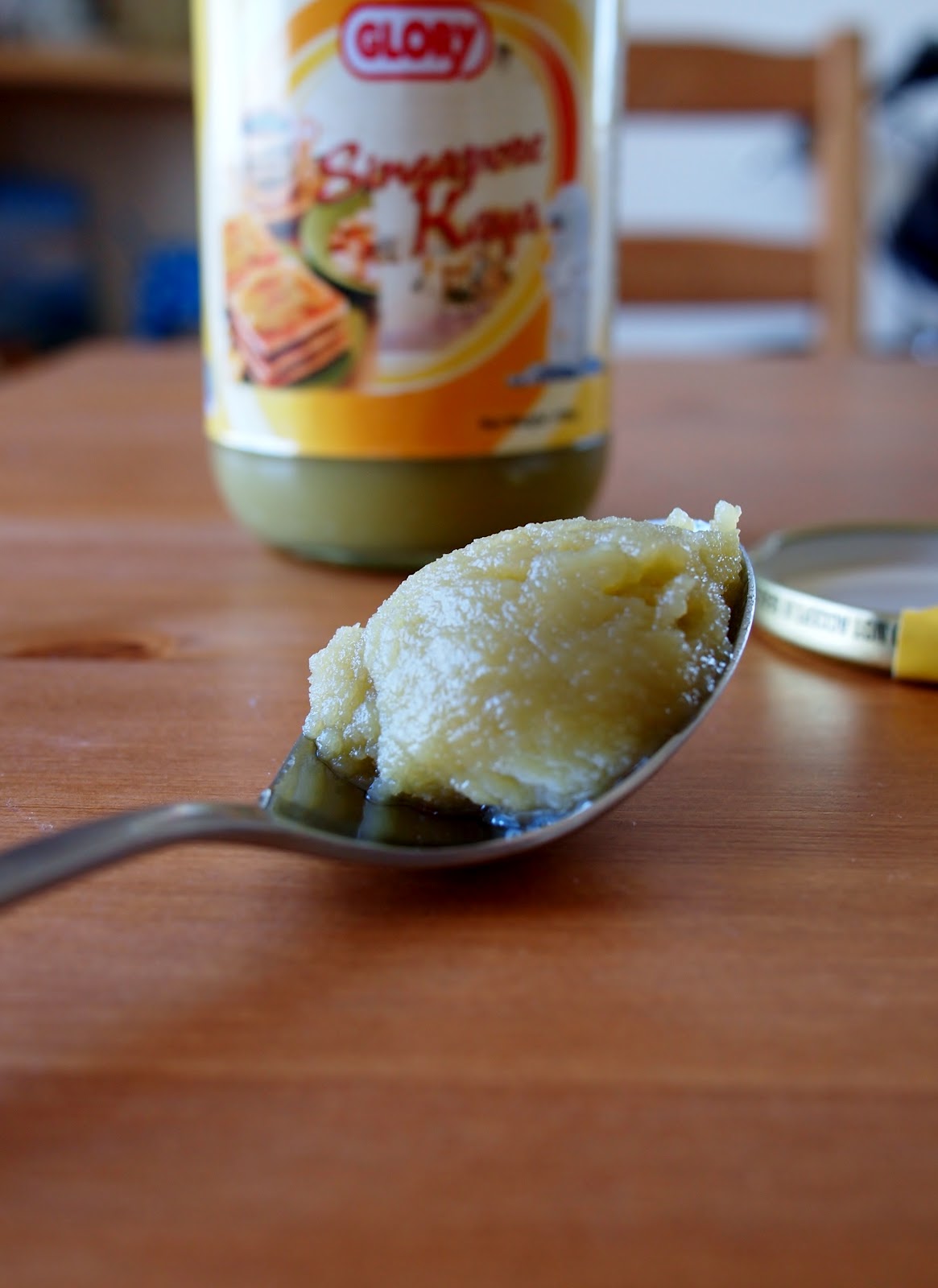
Kaya is one of those new food discoveries we'll be eating long after our breakfast experiment is over.  Basically it's a curd made from coconut and flavoured with pandan leaf.  You can quite easily make it at home, but we cheated and bought a jar from our local T & T Supermarket.


For some reason I was extremely wary of trying kaya, (perhaps it was the slight greenish hue caused by the pandan leaf juice).  However I was relieved to discover that it is extremely tasty.  Think of a smooth coconut jam and you can start to imagine it (but I do encourage you to try this one for yourself!)

At first this breakfast seemed deceptively simple.  Get some bread, slap on some kaya and butter and you're ready to go.  But once we dug a little deeper we discovered a few surprising details.  For starters, the toast used for Kaya Toast should be thin.  In fact, following a video we saw online of a Kopitiam in action we used just one (quite thick) slice of bread for each sandwich.  We toasted it whole and then cut it into two very thin pieces.  This created a nice soft surface for spreading the kaya and butter while retaining the crunchy toast exterior.   Another thing I found very surprising is that Kaya Toast appears to always be eaten with the crusts cut off.  I can only speculate that perhaps this preference dates back to the British period of Singapore's history. (cucumber sandwiches anyone?)


Generally, the thought of sopping your toast in runny egg yolk makes me want to head back to bed, but for the sake of this blog project I persevered and you know what?  It wasn't that bad.  (I feel like the character at the end of Green Eggs and Ham)  Despite a copious amount of salted butter, the Kaya Toast on it's own was too sweet and the egg/soy sauce mixture really helped to add balance to this breakfast.


The Verdict:

For Ease of Preparation:


It's toast, what could be easier?

For Degrees of Separation:


Eggs and toast - familiar, coconut jam and soy sauce - not so much.

For Guestability:


I'm on the fence, would you like this served at your next trip to our apartment?  Let us know.

For Sustainability:


This was a pretty sugary breakfast but the butter and eggs got me through to lunch.

Overall Appeal:


A surprising total for a surprising dish.  While this one wasn't groundbreakingly delicious, it is the only breakfast from this project we've had repeatedly since.  It was sweet, tropical, salty and used items just familiar enough to make it seem like breakfast.  We left the table satisfied.

Don't miss the next post as we finally get to try a typical Filipino breakfast!

Monday, 27 August 2012

Week 8 - Lebanon


KNEFE

And the mystery breakfast is......Knefe from Lebanon!

Knefe (alternatively spelled kanafeh, knafeh, knefeh, kanafa) is one of those foods that instantly entranced me.  I couldn't wait for the weekend to tackle this recipe.

Researching and shopping for our Lebanese breakfast was an eye-opening experience.  I've had my fair share of Shawarma and have even experimented at home with Za'atar and Sumac, but that didn't prepare me for the wonders at Arz Fine Foods (1909 Lawrence Ave. East).  I love visiting new grocery stores and Arz Fine Foods was a wonderland of interesting pastries (the Baklava selection - wow!), fruits, breads, and sundry items.  In fact, while shopping for ingredients to make Knefe at home, we actually came upon a cafe in the store that sold Knefe ready to eat!

Are you wondering yet what Knefe is?  Here's the scoop:  you take a soft, white cheese called Akawi and bake it sandwiched in-between layers of Kataifi mixed with butter.  (Kataifi is a very fine, shredded phyllo dough)  Then you take a fresh sesame bun called a Ka'ak Knefe and place a piece of the Knefe in the bun.  Finally you drizzle with a syrup infused with Rose or Orange Water.


Knefe in it's various forms (there's also a dessert version) is found all over the Middle East, and in Lebanon it's a classic pick-me-up after a hard night out on the town.  People don't often make this one at home but go out and get it from their local bakery instead.

The Knefe we tried from Arz was sweet! (literally)  The syrup reminded me of honey and although cheese with bread on more bread initially sounds like too much white, once you taste it you realize it's more like a breaded protein on a bun  (which isn't very strange at all).  This one got a big thumbs up from Jonny.  It was soft, sweet, warm and comforting, if a tad heavy.

The Verdict:

For Ease of Preparation:


For Degrees of Separation:


For Guestability:


For Sustainability:


Overall Appeal:


I see many more stops at Arz Fine Foods for me in the future, preferably around breakfast....

Later this week we head to South-East Asia for a double-header that features Singaporean and Filipino cuisine, stay tuned!

Saturday, 18 August 2012

Week 7 - Morgenmad - Denmark

ØLLEBRØD

Today's blog entry is dedicated to my Grandma P. who came to Canada from Denmark many years ago.  Enjoy!

Breakfast or Morgenmad in Denmark is a simple affair.  Coffee (a staple in every country it seems), various rolls, cold cuts, cheeses, and jam is the norm for most people.  Other alternatives include Ymerdrys (danish yogurt with a rye bread granola topping), cereal or porridge.  

What about the famous Danish pastry you ask?  Well, although it is popular for breakfast, after some research I discovered that the eponymous pastry actually has Viennese heritage!  Apparently, when the bakers of Denmark went on strike in 1850, bakers from foreign countries, including Austria, were brought in to fill the pastry gap.  Not familiar with Danish pastries the Viennese bakers baked what they knew.  The Wienerbrod (Viennese bread) was instantly popular and voila, the "Danish" was born.  Now of course, Danish bakers have taken the pastry, made it their own and it's become popular around the world.

But for today's entry I wanted something more traditional and simply Danish... Enter the Øllebrød!


When translated, Øllebrød simply means beer-bread and basically it's a warm porridge made from left-over rye bread and beer.  (doesn't that sound delicious?)  It was a staple in Danish cuisine until sometime in the 1800's and there are two theories as to it's origins.  One is that it was invented by Monks who used to dip their old rye bread in beer.  Another says that it was a classic peasant dish, wherein a big pot was kept on the hearth all-day, everyday and as needed old rye bread and beer was thrown in.

Either way, although it's an old-fashioned recipe, from what I can tell Øllebrød has made somewhat of a comeback.  Partly due to renewed public interest in "vintage" recipes and partly due to it's place on the menu of the Copenhagen restaurant Noma.  Rated the #1 in the world, this Danish restaurant focuses on using regional ingredients and culture to sculpt their cuisine.  If Øllebrød was good enough for them, I figured we should give it a go.

Simple enough to make, I concocted a recipe using inspiration from the classic Øllebrød recipe and Noma's version.  The porridge was made using rye bread, beer, water, sugar, lemon juice and a dash of vanilla.  We topped that with sweetened whipped cream and some delicious homemade rye bread croutons.


For such a simple recipe, Øllebrød packed a ton of flavour.  It was tart, sweet, yeasty, bitter and just a little bit salty (from the croutons).  We decided it was probably an acquired taste and although extremely foreign to our palates was one of those dishes that would be craved by those that grew up with it.

The Verdict:

For Ease of Preparation:


If you have an hour or so, you can have Øllebrød.  It wins bonus points for being made with ingredients commonly found in our pantry.

For Degrees of Separation:


Although it resembles porridge, the flavour was far different from anything I've ever tried.

For Guestability:


This would be a really challenging meal to serve guests - unless of course, they're Danish!

For Sustainability:


This is one hearty breakfast, chock full of fiber and protein.

Overall appeal: 


It was fun to delve a little bit in Danish food history and I feel inspired to look into other dishes.  However, I don't know that Øllebrød will be making it back onto our breakfast table in the near future.  It was just a touch too challenging for our taste buds in the morning.

The last two weeks everything's been coming up breakfast!  We've been a little bit breakfast happy and have several breakfasts saved up to show you.  So join us in the coming week for a mystery breakfast.  Will it be Cuban, Lebanese, Singaporean or Filipino......?  (or all of the above)

Sunday, 12 August 2012

Week 6 - The Fry Up - England


“To eat well in England you should have breakfast three times a day.”
W. Somerset Maugham (1874-1965)

As the London 2012 Olympics wind down we want to join in the celebrations, breakfast-style.  So allow us to present:  THE FULL ENGLISH BREAKFAST.

The Full English breakfast or the Fry Up, is one of England's best culinary inventions.  It's the epitome of a hearty breakfast and can include an astounding number of foods:  sausage (bangers), bacon (rashers), blood pudding, white pudding, some form of potato (hashbrown, patty, bubble and squeak), eggs, baked beans, fried tomato, fried mushrooms, and toast.

On our recent honeymoon to London we made sure to try a proper English fry-up.  We went to an awesome cafe, complete with workaday customers and no-nonsense staff...

 The service was quick, the breakfast was salty and delicious, and we were well satisfied until lunchtime...

The Full English Breakfast in London, England

When recreating the Full English at home, we had sausage, bacon, eggs, Bubble and Squeak, fried tomatoes, baked beans and of course, a strong cup of coffee.

Our version at home


As the Full English breakfast long ago transplanted itself into diners across Canada and the USA, this one wasn't new to us.  However there were some differences to what we eat here in North America.  Namely the fried tomato, baked beans and Bubble and Squeak.

The 411 on Bubble and Squeak


Bubble and Squeak is a fried hash made with left-over potatoes, cabbage and whatever other vegetables you have languishing in your fridge.  The story is that as you fry it, it "bubbles" and "squeaks".   And you know what?  It really did!

The Verdict:

For Ease of Preparation:


It didn't take too long to prepare but it did require some serious time-management skills to make sure it was ready all at once.

For Degrees of Separation:


This one probably came as close to home as we'll get during this journey.

For Guestability:


Everyone loves a proper Fry-Up.

For Sustainability:


This breakfast included not one, not two, not three, but FOUR proteins!  We didn't need lunch...

Overall Appeal:


The Full English wasn't a surprise in anyway, but it went down as a favourite nonetheless.  I loved the variety, and really, who doesn't love bacon?

So the Full English breakfast satisfied my English roots, join us next time as we explore what my Danish ancestors ate...