Sunday, 18 November 2012

Week 16 - Cuba

TOSTADA

After last week's exotic Gunfo, I thought we'd stick a little closer to home with the simple Cuban breakfast:  Tostada and Cafe con leche.  Or, toasted buttered bread and coffee with milk.


Now, from all this breakfast research I know that a large portion of the world regularly eats toast first thing in the morning so it would seem silly to feature such an ordinary food.  But so many sources talked about the awesome wonder of Cuban Tostada and actually argued about the best bakery to go for Cuban bread that I figured it was worth investigating.


Cuban bread is fairly simple and is traditionally made in long white loafs similar to Italian or French bread.  It has a secret ingredient however that sets it apart - that old chestnut from our grandmother's kitchen, LARD.

When I set about making Cuban bread I have to admit that I didn't even know where in the grocery story to go to find lard.  After searching the baking and dairy aisle I finally found it hiding among the vegetable oils and pickles and was astonished by it's low price.  (For those foodies out there, I realize that quality lard is best obtained at the butchers.)


Once out of the oven the bread, like all fresh baked bread, smelled great.  In fact it was so inviting that we cheated and skipped the toasting altogether, just smothering the hot bread with butter and stuffing it in our mouths. (It should've technically been toasted like a panini and dipped in our coffee.)



Mmmmmm, it might've been my imagination but I think that maybe Cuban bread did taste creamier and smoother than regular white bread.  Other than that it tasted like.... bread with butter.  But sometimes the simplest things are the best.

The Verdict:

For Ease of Preparation:


I give this a three because as far as breads go it was fairly simple.  It would be even easier if you lived in Miami or Cuba and could just pick this up at your local Bodega.

For Degree of Separation:


Bread with butter, 'nuf said.

For Guestability:


Nothing is more warm, inviting and hospitable than fresh-baked bread.

For Sustainability:


For Overall Appeal:


Though rather ordinary, Tostada was a welcome break or "palate-cleanser" from five crazy months of exotic breakfasts.

Join us next time as we tackle one of the most complex breakfasts yet - traditional Japanese 朝食.


Week 15 - Ethiopia

GUNFO

Ethiopia has a rich culinary tradition and breakfast is no exception.  For the Ethiopian Breakfast entry I could've chosen to make Fit-fit (shredded injeera with spices), Dulet (a spicy meat dish), Fatira (fried pancake with egg and honey), Chechebsa (spicy pancake), or Kinche (spicy cracked wheat).  But for some reason I settled on Gunfo - Barley Porridge with Spicy Butter.


Unfortunately for me, (and my poor mother who was visiting at the time), Gunfo is probably the least delicious of the breakfasts we've made so far.  Even my Ethiopian colleague commented, when she found out we made Gunfo, "Oh no!  Gunfo is not delicious!"  But I digress...

Niter Kibbeh
Gunfo is a stiff porridge made traditionally from barley flour (wheat flour can be substituted).  It's formed into a volcano shape and in the spout you pour Niter Kibbeh (clarified butter infused with garlic, ginger and other spices) and top with a generous helping of Ethiopia's favourite spice mix, Berbere.

Berbere Spice Blend


As we already had some Niter Kibbeh on hand (who doesn't?), and my Ethiopian co-worker had been extremely generous and gotten me some Berbere spice straight from Ethiopia, Gunfo was a snap to prepare and extremely inexpensive.  Just stir water and barley flour over low heat until it forms a thick paste and, presto, you have Gunfo.


As for how it tasted:  I won't say it tasted bad, it was just that the barley flour porridge was extremely bland and had a unpleasant paste-like texture.  The Niter Kibbeh with the Berbere spice was fantastic however.  It was deliciously buttery and spicy and gave a good inkling that probably the other breakfast options that incorporated it would've been great...

The Verdict:

For Ease of Preparation:


Gunfo took a measly 10 minutes on the stovetop to prepare.

For Degree of Separation:


For Guestability:


Sorry Mom!  But thanks for being such a great sport...

For Sustainability:


A little hard to judge as I don't think either of us ate enough to tell.

For Overall Appeal:


I quite enjoy Ethiopian food on the whole, but Gunfo was not something I want to add to my normal breafast rotation.  Perhaps later I'll go back and try one of the other breakfast options Ethiopia has to offer...

Next up, a quick bite in Cuba!

Friday, 9 November 2012

Week 14 - Ontbijt - The Netherlands

HAGELSLAG


It's time.  Time for sprinkles for breakfast!  And they are every bit as good as you imagine.


Sprinkles, jimmies, nonpareils, hundreds and thousands, confetti, hagelslag... the sheer number of names for the humble sprinkle is amazing.  But make no mistake, Hagelslag is a sprinkle above the rest.  Yes, even above the lofty french non-pareil!


Hagelslag (dutch for hailstorm) were officially invented in 1936 by the Venz company.  However some form of chocolately bread topping has been around the Netherlands since at least 1860 from the "Master of Bread Toppings" De Ruijter.  (see box below)


A very popular breakfast choice in the Netherlands, you can buy Hagelslag or their cousin the Vlokken (shavings), in a large array of flavours, shapes and colours.  Word is that the Dutch consume more than 14 million kilos a year!  That's a lot of sprinkles.


The standard procedure for Hagelslag: butter a piece of white bread, sprinkle with Hagelslag and enjoy.  Unlike the German Weisswurst however, Hagelslag is open to interpretation.  You can enjoy it on toast, crepes, ice cream (well maybe not for breakfast), with peanut butter, cream cheese...whatever sparks your fancy.  So far we've tried it standard, toasted and with peanut butter.  And we've tried it a lot.  In fact, since we first tried this breakfast (admittedly several weeks back) we've gone through two whole boxes of Hagelslag!  It's quick and convenient and a lot of fun.  (a component that doesn't make it into a lot of breakfasts)


You bite into the nice soft, fresh white bread, savour the creamy butter on your tongue and as the Hagelslag enter your mouth they melt, almost like you're eating a delicious chocolate frosting spread on bread.  Mmmmmm... As Jon would say: "I wish I was eating them right now."

The Verdict:

For Ease of Preparation:  


It doesn't get any easier than this folks.

For Degree of Separation:


Although made with humble bread, the original use of ordinary ingredients blew my mind.

For Guestability:


For Sustainability:


Overall Appeal:


Some more Hagelslag trivia:

-Supposedly invented when a 5 year old boy wrote DeRuijter asking for a chocolate bread topping.

-Hagelslag must contain over 35% cocoa or they're called "cacao fantasy hagelslag" - AKA fake hagelslag.

-Pink or blue Hagelslag flavoured with anise seeds are a popular baby shower treat in the Netherlands.

Next time we head to Africa and explore how Ethiopians start their day....

Monday, 29 October 2012

Week 13 - New York

BAGEL AND LOX

Well we're back from our mini-vacation in New York and as always the city was amazing!  The lights, the hectic pace, the array of life to partake in.... it's really a special place.  It's particularly special for me and Jon as we got married there one year ago in an intimate ceremony with our close friends and family.  What better way to celebrate our 1st anniversary than to feature New York's specialty breakfast item - the Bagel!

Of course, the bagel is found all over the world.  We used to eat them in Manitoba all the time.  But many people will argue that it's not really a bagel unless it's from New York.  (I won't even touch the New York Bagel vs. Montreal Bagel debate)


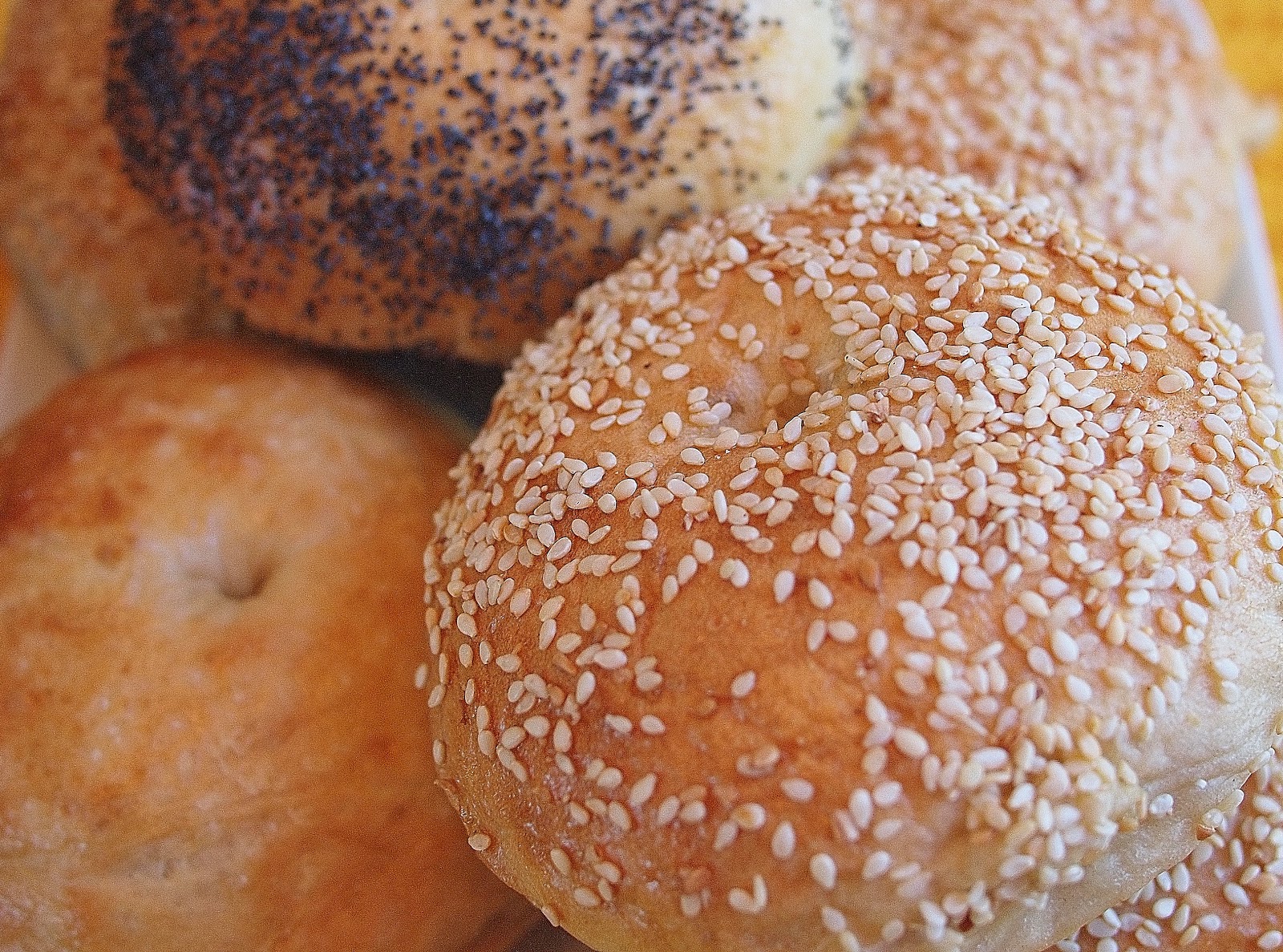
A New York Bagel has to be tough and chewy on the outside and soft and pillowy on the inside.  It's always best eaten fresh (don't toast it!) and since the invention of Philadelphia cream cheese in 1872, it's rarely been eaten without it.

The history of the bagel is obscured in Polish folklore, (many claim it was invented  by an Austrian baker as a horse stirrup-shaped gift for the Polish King Sobieski after Poland saved Austria from Turkish invaders) however it is certain that mass waves of Eastern European immigrants brought the bagel to New York sometime in the 19th century.  Once entrenched in New York, the secrets of bagel-making were closely guarded and entry into the International Bagel Bakers' Union was through father/son relationship only.

Fortunately for me, excellent bagel recipes can now be found online.  (wouldn't those Bagel Artisans of yore be mad!)  The recipe was quite simple and even with the extra boiling step only took about two hours in total.

Bagel toppings are a personal preference affair; they can simply be topped with butter or can be stacked high with ingredients.  For the sake of our experiement I went with the classic set-up:  cream cheese, lox (cured salmon), tomato, cucumber, red onion and capers.


Eating this much on a bagel was a new experience for me - and I liked it!  Despite my reservations, the homemade bagels were well-formed and delicious, and the array of toppings added a great variety of tastes and textures.

The Verdict:

 For Ease of Preparation:


For Degree of Separation:


For Guestability:


Who doesn't enjoy a nice bagel?

For Sustainability:


Bagels can pack a wallop of nutrition and calories.

For Overall Appeal:


If I had fresh New York bagels readily available I would eat one of these every morning.  (although maybe without the lox)

Next time.....SPRINKLES!!!! (for real)


Monday, 15 October 2012

Week 12 - Frühstück - Germany

Hello there!  In honour of that bombastic festival Oktoberfest, I decided to feature Germany this week.  More specifically I settled on Munich and the traditional mid-morning breakfast of Weisswurst!

Weiss-what you say?  Weisswurst is a traditional white sausage from the state of Bavaria.  It is made from finely minced veal and fresh bacon and a selection of herbs and spices that can range from parsley, lemon, mace, onion, cardamom, to ginger.  If you're wondering why sausage in the morning, the answer is actually very pragmatic. Weisswurst is made without preservatives and since refrigeration is a relatively new phenomenon, this sausage was (and is) traditionally made and consumed before the church bell chimes twelve.


Weisswurst is a breakfast snack rife with traditional customs - one of those being that Weisswurst must be accompanied by a Weissbier (wheat beer), a Brezel (soft Bavarian Pretzel), and some sweet Bavarian mustard.  The standard pretzel to sausage ratio is 1:2. (1 pretzel to 2 sausages)  Finding a Weissbier didn't prove very difficult (thank you LCBO), but buying a fresh pretzel was a bit tricky.  Pretzels, like baguettes, are made with little fat and consequently need to be fresh. So what's a girl to do but bake them herself?

At first I was dubious to try this endeavour at home, but in the end I'm glad I took the chance.  The pretzels were A-MA-ZING when done fresh and actually weren't that tricky to prepare. They required very few ingredients (water, baking soda, yeast, brown sugar and flour) and only took about an hour.  One caveat, Brezen are normally dipped in lye before baking and that is what gives them that dark pretzel look.  However, any ingredient that requires googles, gloves and a face mask doesn't seem like a good idea (especially in the morning).  I substituted a baking soda bath instead and still got excellent results.


Weisswurst is made with a thin pork casing that isn't eaten and makes this breakfast a little tricky to eat.  Many web-sites warned of the dangers of eating Weisswurst incorrectly and the apparent dire embarrassment that would follow.  The traditional method of eating Weisswurst even has a name - zuzeln.

Here's how zuzeln works:  You bite off one end of the sausage and then ever so carefully suck the meat out of the casing.  When you get to the half-way point you turn the sausage around and repeat with the other half leaving the used casing discreetly on your plate.  Very... interesting wouldn't you say?


The Verdict:

For Ease of Preparation:


For Degree of Separation:


For Guestability:


I wasn't entirely convinced with the sausage but the pretzels are fabulously hospitable!

For Sustainability:


Yeah, lunch didn't really happen after this....

For Overall Appeal:


Like so many of these experiments I was a little anxious about trying this one.  But once those hot pretzels came out of the oven I was totally game.  The Germans were right, the beer, the pretzel, the mustard, the sausage - it all worked together perfectly!


There are actually several breakfast entries waiting to be written about at the moment and I'm going to try my best to get them finished soon.  Because next week we travel to NYC!!!  (for real, not just in my culinary imagination)


Week 11 - Samoa

SUPOESI

Okay, so we didn't really go on vacation to Samoa (that would've been wonderful), but we did spend a lovely weekend visiting family in Ottawa.  I wasn't inclined to force a random breakfast upon them, but everyone was enthusiastic to join in our project.  So I brought out a recipe I've been saving for awhile - Supoesi, a breakfast soup from Samoa.

I don't have a lot of information about Supoesi and the breakfast culture in Samoa.  From what I've read, food is quite important to Samoans (as it seems to be in most countries) and their national cuisine features lots of local fruit and vegetables like coconut, breadfruit, taro, and bananas.

Supoesi is quite a simple recipe and features only five ingredients - papaya or paw paw, water, coconut milk, sugar and tapioca flour.  It took a while to boil the papaya down to a mushy texture, but other than that it was a snap to prepare.

I've read that even in Samoa, Supoesi isn't a universally loved dish and the taste test results among us reflected that.  I personally didn't enjoy it very much.  It tasted like melon (I hate melons) and had the texture of tapioca pudding.  However, there were several in the crowd that seemed to like it.  And I even heard tell that some ate it days later as left-overs!

The Verdict:

For Ease of Preparation:


For Degree of Separation:


Like Chilaquiles this isn't even close to your morning bowl of Cheerios.

For Guestability:


Everyone was very polite about eating it, but I don't think it has a very big wow factor.

For Sustainability:


I think we all cheated and had some toast with our Supoesi.  Actually, I'm not sure if people in Samoa eat it by itself either.

For Overall Appeal:


This gets a solid three Cheerios rating.  In general, I don't feel completely comfortable judging other countries' breakfasts when I know so little about them and I prepare the recipe myself.  Who knows, maybe I absolutely missed the mark when I prepared it?

Next week - Oktoberfest...